

NCKU Tops 2026 CommonWealth University Citizen Award for Sustainability Governance and Social Responsibility
Written by Amy Lin. Image credit to NCKU Innovation Headquarters.
National Cheng Kung University (NCKU) has won first place in the public large university category at the 2026 CommonWealth University Citizen Award, hosted by CommonWealth Magazine. The recognition highlights the university’s outstanding achievements in governance, teaching, social engagement, and environmental sustainability, reaffirming the solid foundation built through a long-term commitment to University Social Responsibility (USR) and sustainable development.
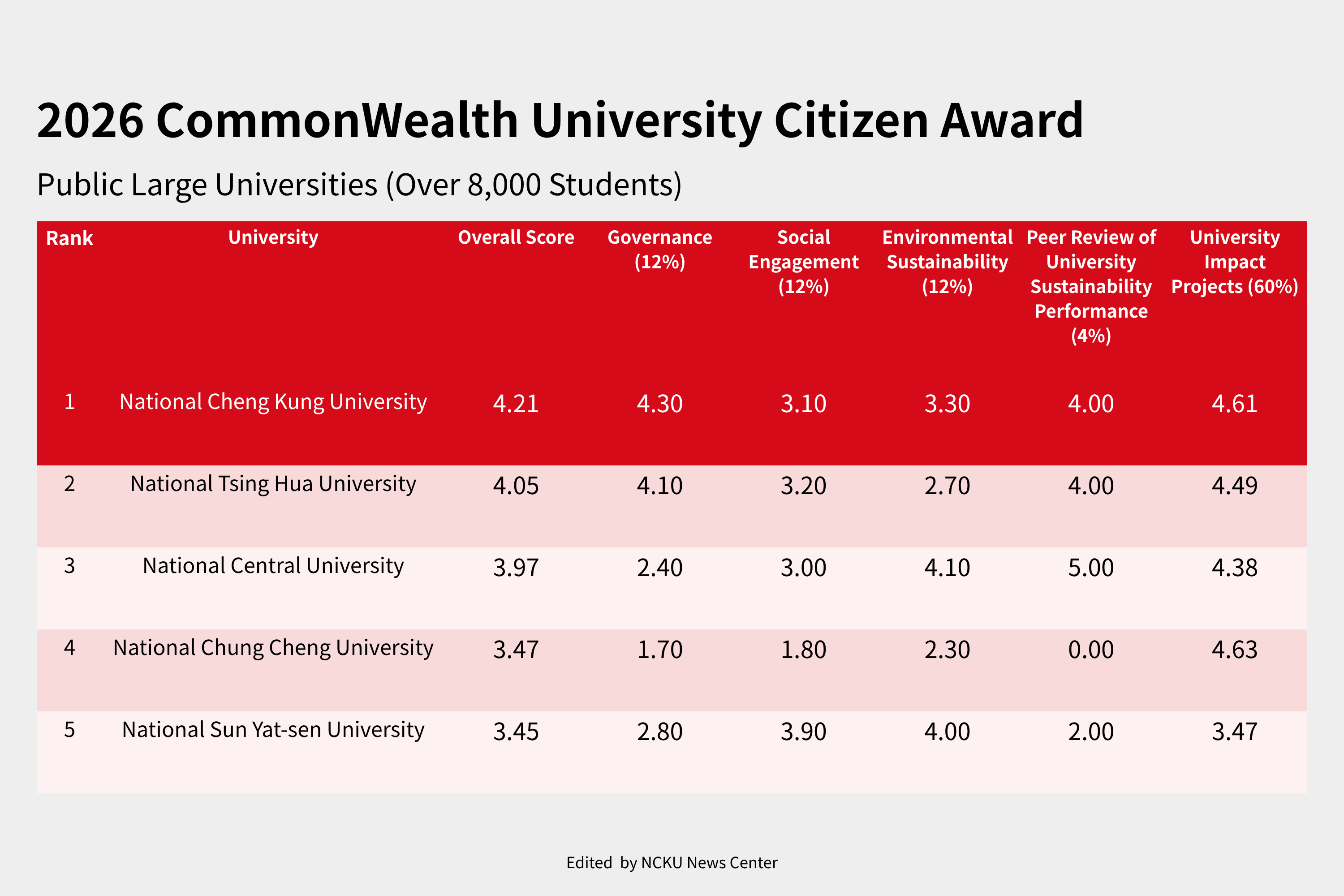
Rankings for the public large university category in the 2026 CommonWealth University Citizen Award. (Source: CommonWealth Magazine)
NCKU has reclaimed the top position in the public large university category, excelling in both project-based and quantitative scores. By integrating internal data with tangible outcomes, the university performed exceptionally well across three key evaluation indicators: University Governance, Peer Review of University Sustainability Performance, and University Impact Projects. Notably, under the University Impact Projects category, NCKU’s Sustainability Leap Program emerged as a major highlight of this year’s evaluation, demonstrating strong results across four dimensions—innovation, external linkages, sustainability, and social impact—and earning unanimous recognition from the judging panel.
The Sustainability Leap Program is anchored in sustainable development, integrating interdisciplinary research capacity and focusing on four core themes: humanistic values, health and well-being, net-zero carbon emissions, and disaster resilience. The program actively addresses critical public issues such as a super-aged society, healthcare resilience, and the net-zero transition. Through institutional design and resource integration, NCKU not only strengthens the linkage between research and teaching, but also embeds sustainability into its university operations.
In terms of sustainable governance, NCKU has advanced institutional and systematic reforms in recent years, incorporating the United Nations Sustainable Development Goals (SDGs) into the core of its institutional development. The university has established cross-unit collaboration mechanisms and performance evaluation frameworks, while enhancing transparency and public trust through information disclosure and stakeholder engagement, demonstrating a leading model of sustainable governance in higher education.
Regarding innovation, NCKU has introduced advanced technologies—including artificial intelligence, AIoT, immersive technologies, and smart sensing—through interdisciplinary integration and field validation. These have been applied across diverse domains, including healthcare, industry, marine environments, and social governance, creating scalable and replicable solutions. In external collaboration, the university has built extensive linkages with more than 40 domestic and international industry–academia–research institutions, forming a collaborative network spanning healthcare systems, industrial chains, and government sectors, effectively narrowing the gap between research and real-world application.
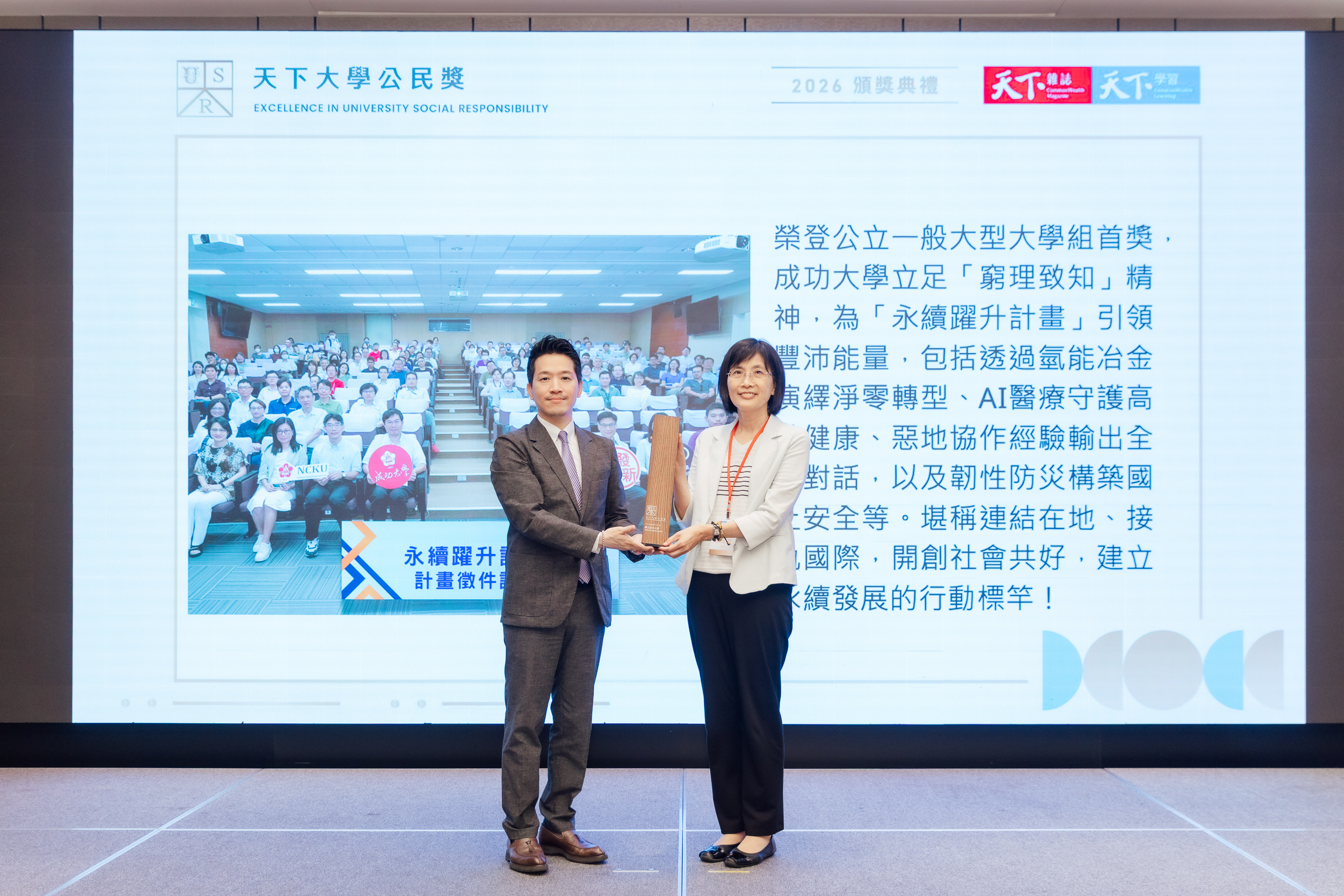
NCKU Executive Vice President Yuh-Neu Chen (right) receives the first-place award in the public large university category from Chih-Wei Ho, Deputy Secretary-General to the President, at the 2026 CommonWealth University Citizen Award ceremony.
Executive Vice President Yuh-Neu Chen accepted the award on behalf of President Meng-Ru Shen at the April 15 ceremony. She said the honor is not only a recognition of NCKU’s achievements but also an important reminder. She noted that the value of a university lies not only in knowledge transmission and talent cultivation but also in its ability to respond to societal needs and fulfill the responsibilities of the times. In recent years, NCKU has advanced institutional innovation with sustainability at its core. Through the Sustainability Leap Program, the university has integrated cross-disciplinary, cross-generational, and cross-SDG initiatives, with about one-third of faculty engaged in related teaching and research, transforming sustainability from concept into practice and demonstrating strong institutional momentum.
Executive Vice President Chen emphasized these achievements are the result of the collective efforts of faculty, students, administrative staff, alumni, and external partners. “Winning first place is both an encouragement and a responsibility,” she said. “We will carry this honor forward with humility and determination, working alongside society to fulfill the university’s commitments to the nation, society, and future generations.”
CommonWealth Magazine noted that since its launch in 2019, the CommonWealth University Citizen Award has drawn on international USR concepts and global sustainability assessment frameworks. It evaluates how universities move beyond traditional academic performance to address societal needs and create public value across four dimensions: governance, teaching, society, and environment. In 2025, judging panel reviews of impact projects were introduced, and in-person interviews were added this year. The weighting of impact projects has been increased to 60 percent, with quantitative indicators accounting for 40 percent. The initiative aims to encourage Taiwan’s higher education system to deepen its work in governance, social engagement, and environmental sustainability, while amplifying its overall societal impact.
Provider:
NCKU News Center
Date:
2026-04-21
Click Num:
Share